 Josie Winfield
Head of Training · 6 November 2025 · 10 min read
Reviewed by
Glenn Coburn
Curriculum Manager at YMCAfit, tutoring and assessing since 2013
Josie Winfield
Head of Training · 6 November 2025 · 10 min read
Reviewed by
Glenn Coburn
Curriculum Manager at YMCAfit, tutoring and assessing since 2013
For more information on our content creation process, view our Editorial Policy.
If you want a plan like this built specifically for your goals, Create’s certified trainers design personalised programmes as part of their courses.”
According to research published in the Journal of Sports Science & Medicine, a 7-day gym split supports muscle hypertrophy by allowing you to work each muscle group 2–3 times weekly. That frequency optimises protein synthesis cycles without compromising recovery, as long as there’s a balance between load, volume, and rest.
Create’s structured personal training courses mirror this principle, teaching you how to manage recovery while maintaining consistent performance. You’ll learn how nutrition supports recovery, enabling you to provide evidence-based advice to your clients.
This is exactly what the Level 3 Personal Training course at Create teaches: how to design programmes around recovery capacity.
It’s the difference between a plan that burns clients out and one that keeps them progressing for months.
Thinking about turning your passion for fitness into a career?
Download our free Info & Price Guide to find out exactly what’s included, how long it takes, and what it costs.
Download the Free Price Guide →
Training seven days a week is a strategic commitment. To sustain that level of frequency without compromising performance or risking over training, the weekly structure must deliberately alternate periods of stress and recovery.
A 2013 review in the Journal of Strength and Conditioning Research highlights that recovery-capable overload drives adaptation, whereas chronic stress without recovery triggers nonfunctional overreaching and, ultimately, overtraining (PubMed).
Create’s advanced programming modules break down this very balance, helping trainers and athletes design systems that adapt over time without performance decline.
Here’s how to stay sharp, strong, and progressing with daily training.
The ACSM progression model provides a framework that supports adaptation without collapse. By programming rest within motion, through variation in intensity, load, and volume, you eliminate the traditional “rest day” while still hitting full recovery targets.
Alternating stress without reducing frequency keeps your system in a constant adaptive state without tipping into exhaustion. Think of it as keeping your foot on the gas, but alternating pressure smartly between the pedal and steering wheel.
Create‘s course content teaches how to bridge theory and application in program design for sustained client results.
Training daily doesn’t equate to chasing PBs every session. Adaptation thrives on precision. A well-built 7-day split incorporates volume manipulation, variation, and strategic deload segments across the cycle. Respect the rhythm: intense load needs contrast to drive long-term progress.
Ready to build a fitness career or expand your training expertise? Explore certified personal training courses at Create.
Want to know what a PT qualification actually costs?
Get the full breakdown — course content, duration, and pricing — in our free Info & Price Guide.
Download the Free Price Guide →
| Day | Focus | Main Muscle Groups | Key Exercises | Sets × Reps | Notes / Training Focus |
|---|---|---|---|---|---|
| Day 1 | Push (Strength) | Chest, Shoulders, Triceps | – Barbell Bench Press- Standing Overhead Press- Dips (weighted if possible) | 4×5–83×6–103×failure | Heavy compound lifts; full ROM; 90–120s rest |
| Day 2 | Pull (Strength) | Back, Biceps | – Conventional Deadlift- Weighted Pull-ups- Seated Cable Rows- EZ Bar Biceps Curls | 4×4–64×6–103×10–123×8–12 | Posterior chain emphasis; maintain core brace |
| Day 3 | Legs (Strength) | Quads, Hamstrings, Glutes, Calves | – Back Squats- Romanian Deadlifts- Walking Lunges- Standing Calf Raises | 4×5–83×8–103×20 steps4×12–15 | Controlled eccentrics; tempo for tension |
| Day 4 | Active Recovery + Mobility | Full Body / Joints | – 30-min Walk- Foam Rolling- Mobility Drills- Band Activation Work | — | Low-intensity movement; promote recovery & mobility |
| Day 5 | Push (Hypertrophy) | Chest, Shoulders, Triceps | – Incline Barbell Bench Press- Arnold Press- Skull Crushers | 3×8–123×10–123×12–15 | Focus on TUT (time under tension); 60s rest |
| Day 6 | Pull (Hypertrophy) | Back, Biceps, Rear Delts | – Barbell Bent-Over Rows- Face Pulls- Preacher Curls | 3×8–103×12–153×10–12 | Combine leg hypertrophy with core stability; finish with an incline walk |
| Day 7 | Legs + Core Integration | Quads, Glutes, Core | – Front Squats- Leg Press- Barbell Glute Bridges- Weighted Planks | 4×6–83×10–123×8–103×30–45s | Combine leg hypertrophy with core stability; finish with incline walk |
The week opens with a heavy push session focused on multi-joint lifts. These exercises activate large muscle groups, stimulate anabolic hormone release, and set the tone for the training split.
Push hard with progressive loads and a full range of motion on every rep. Don’t rush rest periods—90 to 120 seconds sustains output across sets.
Shift to the posterior chain with vertical and horizontal pulls. Deadlifts lead the day with max intensity and neural demand, while secondary lifts refine pulling power and arm size.
Every pulling movement in this session works through the same fundamental structures: muscle fibres contracting via actin-myosin interaction, force transferred through tendons to bone.
Understanding this changes how you coach the movement, how you cue clients, and how you identify when form is breaking down under fatigue.
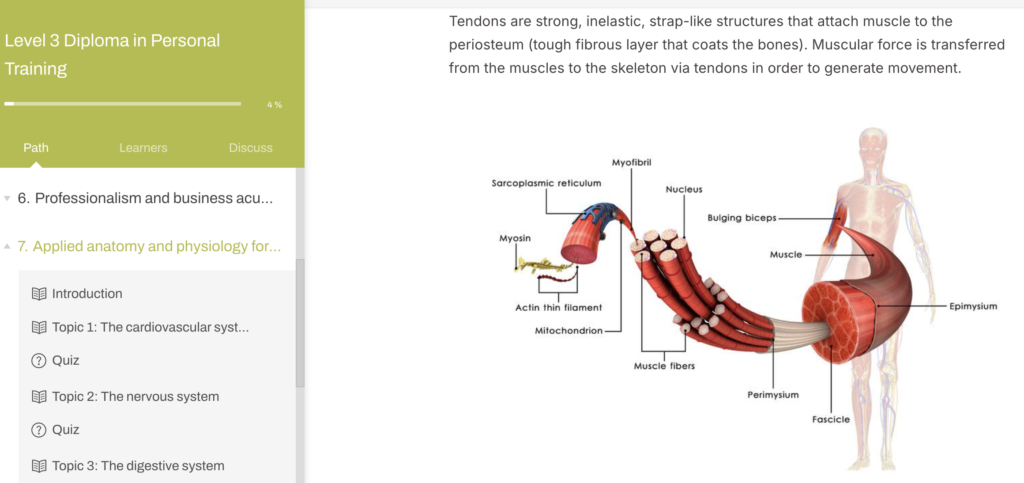
For trainers, this is the foundation that makes everything else make sense. When you know what’s happening inside the muscle, you stop guessing and start coaching with precision.
Explore the L3 Personal Training course →
Ready to coach with this level of precision?
Find out everything you need to know about getting qualified — download our free Info & Price Guide today.
Download the Free Price Guide →This is your lower body strength session. Intensity must be paired with control. Quads and hamstrings take centre stage, supported by strategic accessory work.
Use tempo cues—lower with control, explode upward—to maximise muscular tension and avoid momentum-based lifting.
No iron today, but movement stays on the schedule. Reduce lifetime fatigue accumulation while maintaining high circulation and joint fluidity.
Use therapy balls and floor-based drills to break up adhesions and restore range of motion where movement patterns feel limited.
Understanding why active recovery works and how to prescribe it for different clients is a core module in Create’s L3 Personal Training course. If you’re a trainer, this is the kind of nuance that separates good programming from great programming.
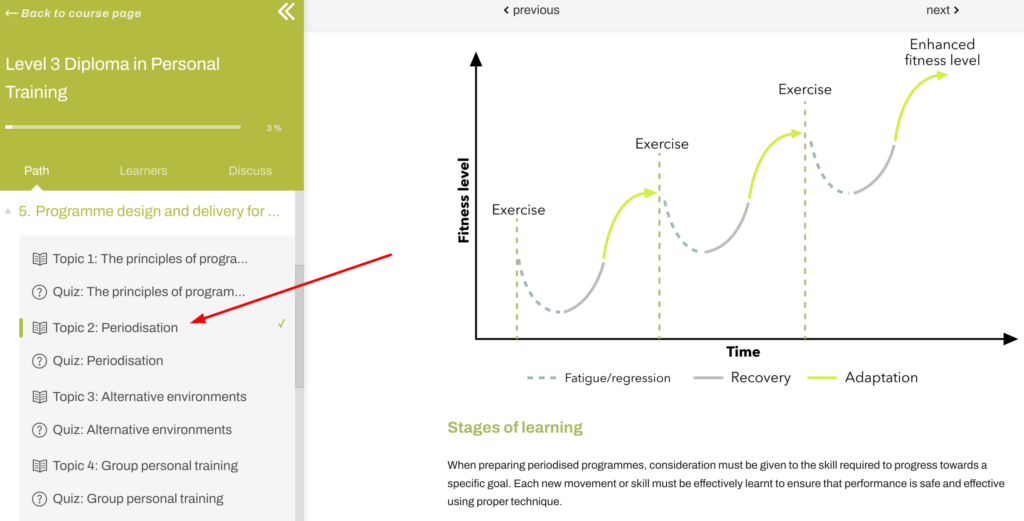
The graph above is taken directly from the course material.
Each dip represents fatigue after a training bout, the grey curve is recovery, and the green curve is adaptation, the point where fitness improves beyond the previous baseline.
Day 4 in this plan is designed to sit in that recovery window deliberately, so that Days 5–7 land during the adaptation phase.
If you’re a trainer, or aspiring to be one, this is the kind of programming logic that separates evidence-based coaching from guesswork.
This is the kind of knowledge you’ll teach your clients.
Curious about what the full L3 PT course covers? Download our Info & Price Guide for the complete picture.
Download the Free Price Guide →Return to push-style training, but switch gears to hypertrophy. Movements shift toward angles and contractions that isolate. Time under tension becomes the priority.
Rest for around 60 seconds between sets. Keep joints stacked, motion strict, and full contractions at the top of each rep.
Stay in hypertrophy territory with targeted pulling movements. Build upper back thickness and arm size by managing rep quality and lifting cadence.
Slow down each negative rep and initiate every pull from retracted scapulae. Finish each curl with an isometric pause.
This final strength day mixes leg hypertrophy with core accountability. The midline must stabilise under load, so every compound lift trains more than one system.
Finish the day with a 10-minute incline treadmill walk. This cooldown flushes lactate, lowers sympathetic drive, and reinforces sustainable training capacity.
Trending routines and flashy fitness gimmicks won’t carry you through a 7-day gym routine.
Consistency and structure will. To thrive in a daily workout schedule, you need more than a good playlist and fancy gear. You need a roadmap built on recovery, fueling, and focused execution.
Training every day demands intelligent recovery. Overuse injuries don’t stem from frequency alone—they develop when workouts outrun your body’s healing capacity. Counter this with built-in recovery strategies and strategic workout splits.
Showing up at the gym daily with low glycogen reserves or inadequate protein intake guarantees a plateau or breakdown. Your nutrition drives adaptation.
Create’s PT courses cover applied nutrition as part of the curriculum, not just the numbers, but how to translate them into practical advice you can give clients with different goals and lifestyles.
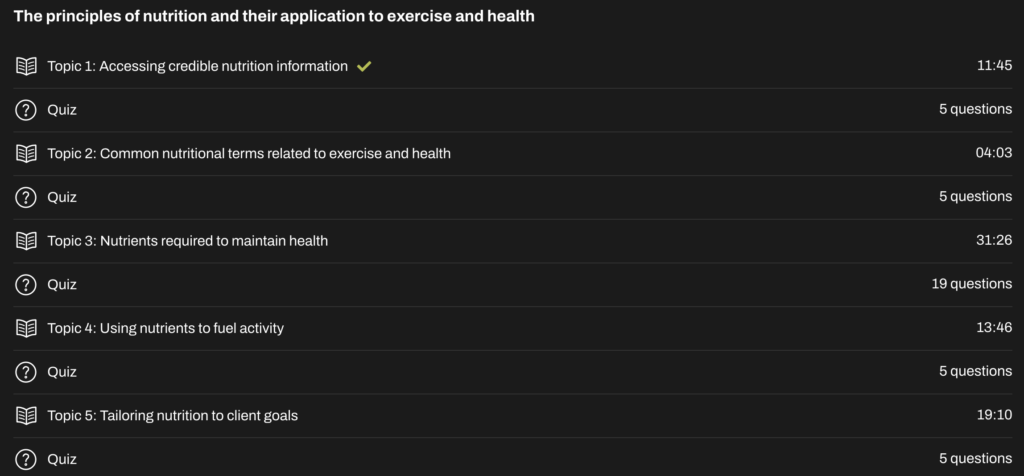
The nutrition module inside Create’s L3 PT course covers everything from accessing credible nutrition information to tailoring macros to individual client goals.
Topic 5 alone, Tailoring nutrition to client goals, runs nearly 20 minutes and is paired with assessed quizzes, so you’re not just learning the theory, you’re being tested on your ability to apply it.
If you’re serious about coaching others (or optimising your own training), that’s the level of nutritional literacy that makes the difference.
Serious about coaching others on nutrition and training?
See exactly what Create’s L3 PT course covers and what it costs — download the free Info & Price Guide now.
Download the Free Price Guide →If you’re following this plan and thinking about turning this knowledge into a career, Create’s Level 2 Gym Instructing and Level 3 Personal Training courses are built around exactly these principles:
You don’t need a garage full of machines, but you do need access to the basics. A 7-day gym plan draws power from fundamentals done consistently:
You’ve chosen seven days. Be clear on your why.
Then build every rep, bite, nap, and rest session to match it. This approach doesn’t just build physiques—it rewrites your limits.
Ready to take the next step?
Download our free Info & Price Guide and find out how Create can help you turn your training knowledge into a certified career.
Download the Free Price Guide →
Josie Winfield
Head of Training
Josie has worked in fitness for eight years, first as a personal trainer and now as a tutor and assessor at Create. She has competed in CrossFit at elite level and specialises in nutrition.
Reviewed by Glenn Coburn, Curriculum Manager at YMCAfit, tutoring and assessing since 2013.
More about Josie →