You already answer nutrition questions every week, carefully and for free. This is the regulated Level 4 that lets you answer them properly. Around 400 hours of applied learning, so you finish able to be the reason a client finally stops guessing, and able to charge for it.
Most nutrition courses hand you a certificate and leave you to work the rest out on real clients. The science is rarely the gap. The gap is the moment a client sits down, tells you what is actually going on, and expects you to know what to do.

This is a regulated Level 4 qualification with the applied coaching and business training Create builds around it. Around 400 hours across 16 modules, built around a regulated qualification of 331 hours, taught by doing rather than reading. You build from evidence-based thinking and the science of how the body works, to coaching everyday clients, to specific populations and athletes, then to running it as a business.
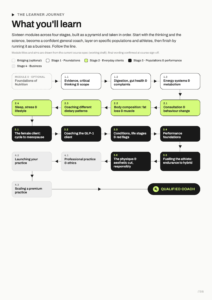
Sixteen modules across four stages. You start with how to tell a real finding from a good headline, and finish with how to price a coaching package. In between you learn to coach everyday fat loss and muscle gain clients, women across the cycle and through menopause, clients on weight-loss medication prescribed and supervised by a clinician, clients living with a diagnosed condition, and endurance, strength and hybrid athletes.
You finish able to sit across from a client, hear what is really going on, and know what to do about it. That is the whole job, and it is what you get paid for.
Every trainer has the conversation. What should I be eating. Should I be tracking. Is this diet worth it. Most answer carefully, from what they picked up at Level 3, and then change the subject when it gets specific. The advice is not the problem. Being unqualified to charge for it is. The knowledge gap is smaller than you think. The qualification gap is the one costing you clients.
Built as a pyramid. Start with the thinking and the science, become a confident general coach, layer on specific populations and athletes, then finish by running it as a business.
Before any heavy science, you build the lens you will use for the rest of your career. Learn what evidence-based practice actually means, how to tell evidence from eminence and anecdote, and how to read a research paper critically: what it set out to test, who it tested, how big the effect really was, and where it over-reaches. Then a repeatable framework for taking apart any diet or claim a client brings you, and how to say so tactfully rather than dismissively.
The digestive system, the enzymes and absorption sites, and the roles of the liver and pancreas. How carbohydrate, protein and fat are digested, absorbed and transported. The gut microbiome and how diet and exercise influence gut health. Then how to support common, non-clinical complaints within scope, and how to recognise when a symptom needs a referral for diagnosis rather than a coaching plan.
The three energy systems and how they overlap across intensity and duration. How fuel use shifts between fat and carbohydrate, and between fed and fasted states. Then the practical half: the components of total daily energy expenditure, how to estimate a client's requirements using recognised equations, and where those equations fall down. You finish able to explain metabolic adaptation honestly and put the broken metabolism myth to bed.
Screening, client agreements and informed consent before you gather anything. Then how to run a consultation that gets the real picture, and how to build rapport from first contact. You turn what you hear into SMART goals, learn the behaviour-change models that explain why clients stall, and the motivational interviewing skills to move them on. You finish able to spot barriers before they derail the plan.
Set an appropriate deficit, surplus or maintenance, and understand what happens when you get it too aggressive or too timid. Coach fat loss with enough protein to protect lean mass and the right training alongside it. Coach muscle gain, including protein distribution and the role of carbohydrate. Plan across time with diet breaks, refeeds and reverse dieting. Compare the ways of measuring progress and interpret them sensitively. You also learn to recognise disordered eating and low energy availability at an awareness level, and to refer promptly and supportively.
Vegetarian, vegan, cultural and religious eating are stable choices to support and optimise, not trends to audit. Coach plant-based clients well, optimising protein quality and managing the micronutrient blind spots that come with it. Account for cultural and religious dietary practice and adapt guidance respectfully around it, rather than asking clients to work around you.
How sleep affects appetite, food choice, recovery, muscle growth and fat loss, and how to coach practical sleep and light hygiene. How stress affects appetite, body composition and adherence, and the habits that help. The roles of daily movement, alcohol and social eating, and how to fold all of it into one plan a client can live with.
The phases of the menstrual cycle and how they can affect appetite, cravings, energy, performance, recovery, fluid balance and scale weight. How to give individualised guidance for clients who want to work with their cycle, while being honest about the limits of the current evidence, and accounting for hormonal contraception. Recognising menstrual irregularity as a possible sign of low energy availability. Then nutrition across the female lifespan, including perimenopause and menopause, with a focus on body composition, bone density, muscle mass and protein needs.
What GLP-1 medications are, at an awareness level. Then the coaching mechanics for a client whose medication is prescribed and supervised by a clinician: protein-first planning around a suppressed appetite, strategies for medication-related food aversions, protecting lean mass with resistance training, and keeping nutrition adequate on a much smaller intake. Then supporting the behavioural transition and planning for life after the medication. Coaches do not prescribe, advise on dosing or manage side effects. Medical questions go back to the prescriber.
Coaching older adults within scope: energy and protein needs, muscle and bone health, hydration, and the barriers that get in the way. Then the core of the module: working safely with clients who have a diagnosed, stable, medically managed condition, on their general healthy eating and body composition goals, in collaboration with their healthcare team. You work the boundary case by case, so you know precisely what supporting a client looks like and where it would tip into treating a condition. You finish with a clear referral blueprint.
Read any activity's demands and turn them into a fuelling approach. Carbohydrate periodisation and protein requirements, including daily targets, distribution and timing. Hydration for health and performance, covering electrolytes, sweat rate variation and the effect of environment and alcohol. Then supplements and ergogenic aids, separating strong evidence from weak, understanding contamination and anti-doping risk, and defaulting to food first.
The endurance athlete: energy and carbohydrate needs, in-event fuelling, gut training, recovery refuelling and event-weekend timelines. The strength and power athlete: fuelling high-quality training and recovery, lean mass goals, and gaining size or reducing fat while holding strength. The hybrid athlete, meaning CrossFit, Hyrox and functional fitness: fuelling concurrent strength and endurance, repeated high-intensity efforts, and a whole competition day.
A physique or photoshoot cut is an optimised, periodised extension of the fat loss principles from Stage 2, applied to a time-bound goal. Plan the timeline, protect lean mass and training quality, manage the deficit sensibly, and build in the recovery and reverse diet afterwards, so the cut is a phase rather than a destination. You also learn the physiological and psychological risks of pursuing very low body fat, and how to recognise when a client's pursuit of leanness is tipping into something harmful. No extreme-cut or peak-manipulation protocols are taught.
Using and storing client information in line with GDPR, confidentiality and record-keeping requirements. Client agreements, terms of service and informed consent in day-to-day practice. Maintaining your competence through CPD and reflective practice, and keeping scope and referral discipline sharp once nobody is marking your work.
Define your offer, your target client and your value proposition, and choose a niche without narrowing so far that nobody fits. Price and position one-to-one, online, hybrid and group work, and price it profitably rather than nervously. Generate leads through content, social media, referrals and partnerships with PTs and gyms, and convert an enquiry into a client ethically.
What actually drives retention: results, communication cadence, relationship and accountability, and how progression and ongoing support build lifetime value. Scalable and higher-value delivery models, from structured online one-to-one to hybrid group programmes and corporate wellness, plus the handful of numbers worth tracking. Then ethical marketing: honest claims, no guaranteed outcomes, and staying in scope in everything you publish.
Brings you to the Level 3 nutrition baseline if you do not already hold it. Nutritional terminology, macronutrients and micronutrients, the Eatwell Guide and how needs vary by age, sex and activity, key micronutrients and who is at risk of falling short, energy balance, blood sugar and glycogen, hydration, alcohol and health, why fad and crash diets fall down, food labelling, and a first look at scope of practice and telling credible sources from the rest. Non-assessed, worked through at your own pace.
You finish with a regulated Level 4 qualification, awarded by Focus Awards and regulated by Ofqual. Create is an approved Focus Awards centre, and the course is written and delivered in house. The regulated qualification is 331 hours. The full Create programme runs to around 400, because the applied coaching and the business modules sit on top of what the qualification requires.
You finish withFocus Awards Level 4 Certificate in Nutrition for Weight Management and Athletic Performance, regulated by Ofqual under qualification number 603/5682/0
You finish with the Focus Awards Level 4 Certificate in Nutrition Coaching, Ofqual regulated. It qualifies you to coach nutrition with clients within a defined scope of practice, and to be insured for it. It does not make you a dietitian, and the course is clear throughout about where the line sits and when to refer on.
You build a portfolio of evidence, assessed internally by Create and quality assured by Focus Awards. It is designed to look like the work of a coach, not the work of an exam candidate.
Knowing your scope is what makes you safe and trusted. The principle is simple: the boundary is the activity, not the person.
You become a qualified nutrition coach, not a registered nutritionist. We are always clear about the difference. Having a condition is not itself a reason to refer. Needing it treated is.
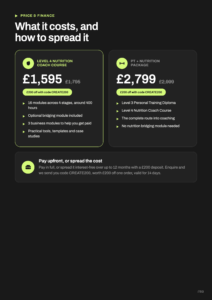
Drag the deposit and the term. Every figure updates, including the total you would pay by the end.
If you already hold a Level 3 PT qualification, the Level 4 is the natural next step and you can skip the bridging module. If you are starting from nothing, the PT and Nutrition package gives you both and is the cheaper route to the same place.
A nutrition coach works with apparently healthy clients on food, habits and performance. A registered nutritionist has a different route and a wider remit. We are clear throughout about which one you become, and where the line sits.
No. The optional bridging module covers macronutrients, micronutrients, energy balance and the main food groups, so you can follow the rest whatever you are starting from. It is included.
Yes. You finish with the Focus Awards Level 4 Certificate in Nutrition for Weight Management and Athletic Performance, QRN 603/5682/0, regulated by Ofqual. Create is an approved Focus Awards centre.
Yes, and three of the sixteen modules are about how. You cover defining your offer, pricing one to one, online and hybrid packages, finding clients and keeping them, so it becomes a paid service rather than free advice inside a session.
Yes. The course is studied online at your own pace, and the consultation and behaviour change work is built for remote coaching as well as in person.
No. Many learners arrive with a Level 3 PT qualification, which covers the nutrition baseline. If you do not have one, an optional bridging module brings you up to speed. It runs to around 40 hours and is not assessed.
The regulated qualification is 331 hours of Total Qualification Time. The full Create programme is around 400 hours across 16 modules, studied online at your own pace. You have 12 months of access.
You build a portfolio of evidence, assessed internally by Create and quality assured by Focus Awards. Worked assignments, real client case studies and practical coaching tasks. Marking within 72 hours, and free resubmissions for as long as you have access.
No, and no honest course can promise that. You become a qualified nutrition coach. We are always clear about what that does and does not let you do.
The question comes up every week. Twelve months from now you could be the one answering it properly, for the client in front of you and the ones you currently send elsewhere.