 Josie Winfield
Head of Training · 19 October 2023 · 7 min read
Reviewed by
Glenn Coburn
Curriculum Manager at YMCAfit, tutoring and assessing since 2013
Josie Winfield
Head of Training · 19 October 2023 · 7 min read
Reviewed by
Glenn Coburn
Curriculum Manager at YMCAfit, tutoring and assessing since 2013
For more information on our content creation process, view our Editorial Policy.
As a personal trainer your job is not just coaching people on how to perform exercises. Often you’re as much counsellor as you are fitness coach. Behaviour change is not as simple as you may perceive it to be, most people know that exercise and a healthier lifestyle would be beneficial for them, they just have certain barriers in the way.
These barriers may be mental, such as a lack of confidence or motivation, or they may be physical such as financial reasons or lack of resources. Helping people overcome these barriers and build lasting behaviour changes is a large part of your role as a personal trainer. In this article we talk about the popular transtheoretical model for behaviour change and how to use it as a PT.
The transtheoretical model (TTM) for behaviour change proposed by Prochaska and Velcier (1997) identifies:
There are four core constructs within TTM:
There are five main stages of behaviour change:
Termination is a theorised end-point rather than a stage and is not achievable for behaviours such as physical activity and healthy eating.
Relapse is not considered a stage of change but describes the process of moving backwards in the model – typically only by one or two stages, although occasionally it can mean returning to pre-contemplation.
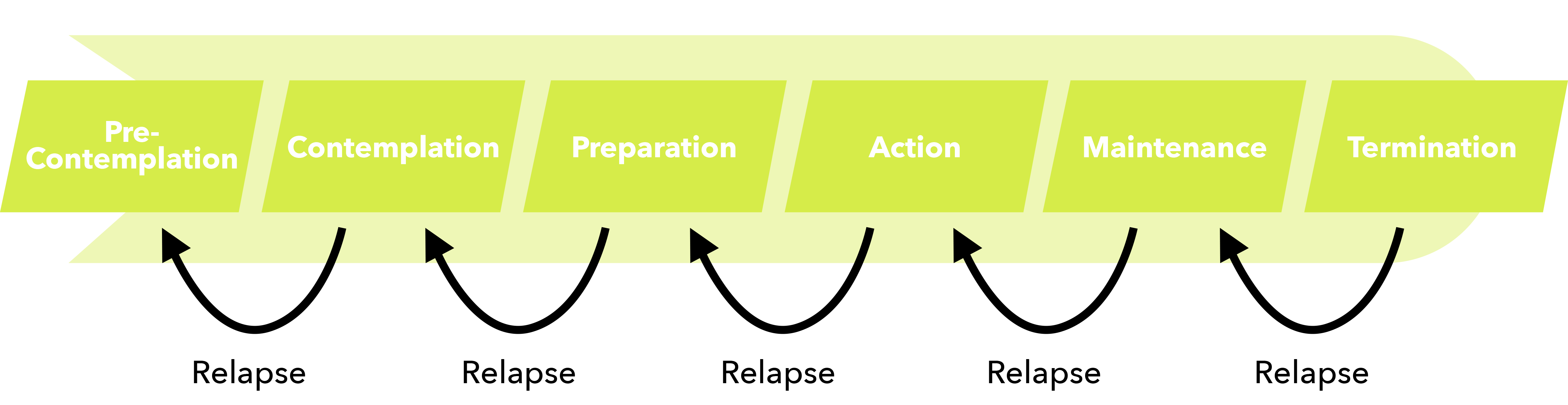
Despite the linear format of the model, it is commonly accepted it is not normal for individuals to progress smoothly through it in a linear fashion. Relapse is accepted as a normal part of the learning process and for most individuals it takes four or five serious attempts at changing a problem behaviour before the new, desired behaviour is maintained. This has important implications for setting realistic client expectations, dealing with setbacks and exploring what has been learned from past experiences.
These are the internal attitudes (cognitive beliefs) and observable strategies (behavioural interventions) that individuals use to progress through the stages of change. There are ten processes that are well supported by research and these can be used as a guide when structuring behaviour change interventions to have the greatest impact. Support and motivation offered by a skilled professional is one way of encouraging this commitment. During the initial consultation, the skilled professional will get to know a little about the client’s motivations and barriers for making change. They will continue to learn more about the client as the working relationship and level of trust develop.
| Stage of change | Client attitude (cognitive) | Intervention (behavioural) | Client type |
|---|---|---|---|
| Pre-contemplation | Denial of any need to change. ‘I don’t see why I should exercise.’ | Active listening. Provide information, e.g. handouts. | Might be accompanying a friend |
| Contemplation | Considering change, but need to overcome internal conflicts – barriers versus motivation. ‘I know I should be more active but I just don’t have time right now.’ | Active listening. Explore the client’s motivation and barriers. Use delusional balance grid. Use reflective statements and summaries. | Saw an advert online for an open day |
| Preparation | Small changes are made. ‘I’ve chosen the outfit I want to wear comfortably again by my next holiday.’ | Active listening, praise and encouragement. Goal-setting. Explore support systems, rewards and incentives and relapse prevention strategies. | Has a free pass to see if they like it |
| Action | Changes made – one day to six months. ‘I’ve stopped buying fast food and cook all my meals at home.’ | Active listening, praise and encouragement for changes. Review goals. Explore support systems, rewards and incentives and relapse prevention strategies. | Current member |
| Maintenance | Changes sustained for beyond six months, some coping strategies in place. ‘Running is just a part of my normal routine now; I don’t think I’d ever want to stop.’ | Active listening, praise, encouragement and building confidence. Review goals and highlight successes. Discuss triggers for relapse. Increase strategies to manage relapse. | Moving from a different gym |
| Relapse | Return to old behaviour. ‘Since I got this knee injury, I haven’t been able to run. I guess that’s it for me now, probably just getting too old for this exercise nonsense.’ | Active listening, empathy and non-judgement. Explore triggers for relapse. Normalise experience (not failure, opportunity to learn). Discuss re-planning. Review and action plan. | Going to quit |
The ten processes of change that have been identified are below, with some processes being more relevant to a specific stage of change than other processes. These processes result in strategies that help people make and maintain change.
| Process of change | Description |
|---|---|
| Consciousness Raising | Increasing awareness about the healthy behaviour |
| Dramatic Relief | Emotional arousal about the health behaviour, whether positive or negative arousal |
| Self-Reevaluation | Self reappraisal to realise the healthy behaviour is part of who they want to be |
| Environmental Reevaluation | Social reappraisal to realise how their unhealthy behaviour affects others |
| Social Liberation | Environmental opportunities that exist to show society is supportive of the healthy behaviour |
| Self-Liberation | Commitment to behaviour change based on the belief that achievement of the healthy behaviour is possible |
| Helping Relationships | Finding supportive relationships that encourage the desired change |
| Counter-Conditioning | Substituting healthy behaviours and thoughts for unhealthy behaviours and thoughts |
| Reinforcement Management | Rewarding the positive behaviour and reducing the rewards that come from negative behaviour |
| Stimulus Control | Re-engineering the environment to have reminders and cues that support and encourage the healthy behaviour and remove those that encourage the unhealthy behaviour |
All of the above processes may not be relevant to you as a personal trainer, however you can have an impact on most of these.
Decisional balance is a process of weighing up the pros and cons of making a change for a specific behaviour. When clients consider making changes, they weigh up the benefits and sacrifices (or barriers). They will see the benefits and the positive reasons for making a change but they may also see all the things they will have to give up or start doing to make the change happen. If the benefits outweigh the barriers, the change will be made. If the benefits continue to outweigh the barriers, the change will be more likely to be sustained.
| Advantages of changing | Disadvantages of changing |
| ‘I would be fitter than I am.’ ‘It could help me to feel better.’ ‘I would have more energy.’ ‘I would feel better about myself.’ | ‘I would have to find a way to summon energy that I don’t have.’ |
| Advantages of not changing | Disadvantage of not changing |
| ‘I can stay as I am. I don’t have to do anything.’ ‘I don’t have to find time or energy. | ‘Nothing will change.’ ‘I could end up feeling worse than I do now.’ ‘My health could suffer.’ |
There will always be reasons to change and reasons not to change which are constantly being evaluated, shifted in priority and re-evaluated in the mind of each individual. Often the benefits and disadvantages of changing are not consciously considered, awareness of these is at an unconscious level. A conscious decision is not made on each occasion that an individual engages in an unhealthy behaviour. The behaviour has become the result of an unconscious choice or habit. Asking an individual about the pros and cons of a behaviour raises their awareness of it, causing them to re-evaluate their current habitual choices.
Self-efficacy is an individual’s confidence about a specific situation or activity and the extent to which they think they can do it (their perception of the ease or difficulty of the task). Self-efficacy is important for developing the motivation to change and determining the level of perseverance to maintain a change. If a client thinks they can do something and believes their actions will make a difference, their motivation will be higher.
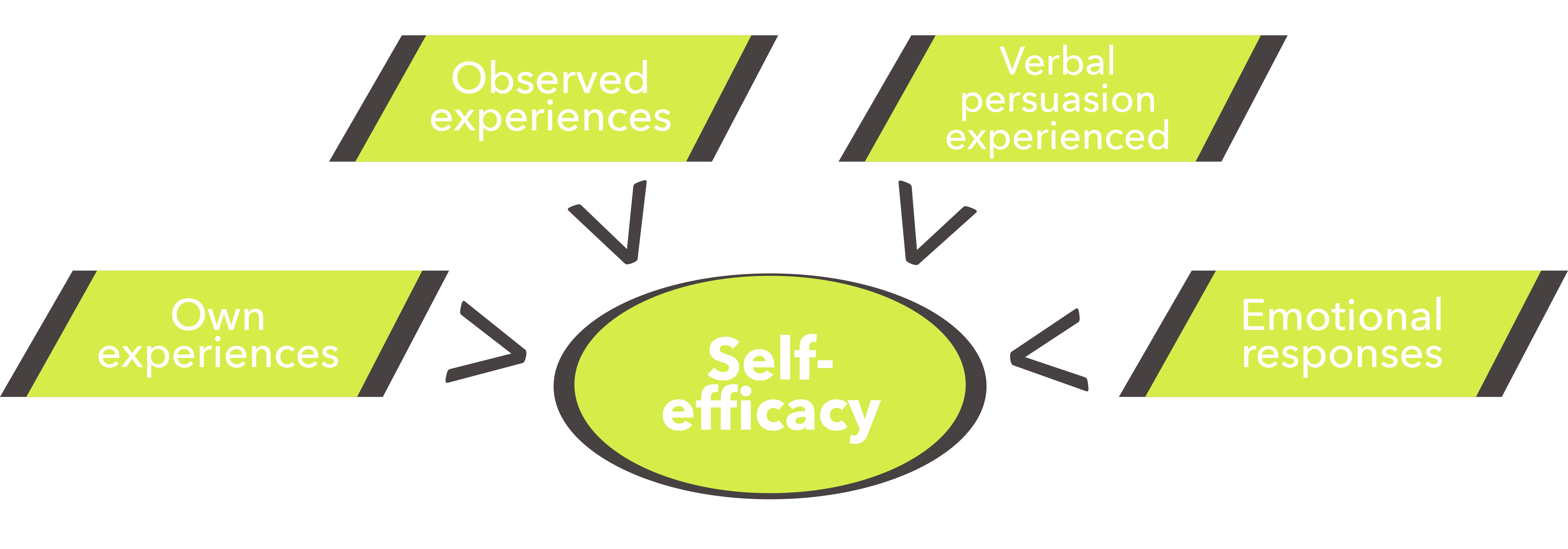
Understanding this process can help you influence clients or friends and family to make positive behaviour changes. The next step for you once they’re on this journey of behaviour change is to work with them to understand and set some realistic goals they can start working towards, hopefully with your help!
Our personal training courses go into much more depth on this topic and more to help you understand how best to help your clients. If you’re interested, get in touch and you can get started straight away.
Josie Winfield
Head of Training
Josie has worked in fitness for eight years, first as a personal trainer and now as a tutor and assessor at Create. She has competed in CrossFit at elite level and specialises in nutrition.
Reviewed by Glenn Coburn, Curriculum Manager at YMCAfit, tutoring and assessing since 2013.
More about Josie →