 Robert Taylor
Head of Marketing · 10 March 2025 · 10 min read
Reviewed by
Ollie Bell
Award winning, published author, certified at Harvard and Oxford
Robert Taylor
Head of Marketing · 10 March 2025 · 10 min read
Reviewed by
Ollie Bell
Award winning, published author, certified at Harvard and Oxford
For more information on our content creation process, view our Editorial Policy.
If you’re not aware of what franchising is, it’s a business model where an individual (the franchisee) buys the rights to operate a business under an established brand (the franchisor). In exchange for an initial investment and ongoing fees, the franchisee gains access to a proven business system, brand recognition, operational support, marketing resources, and industry expertise.
In the fitness industry, franchising allows entrepreneurs to open and operate a gym or fitness centre under a well-known brand, such as Anytime Fitness, F45, or Snap Fitness. Instead of building a gym from scratch, franchisees benefit from turnkey solutions, including standardised equipment, membership structures, technology systems, and corporate-driven marketing campaigns. The franchisor provides guidance on location selection, staff training, operational procedures, and customer acquisition, reducing the risks typically associated with launching an independent gym.
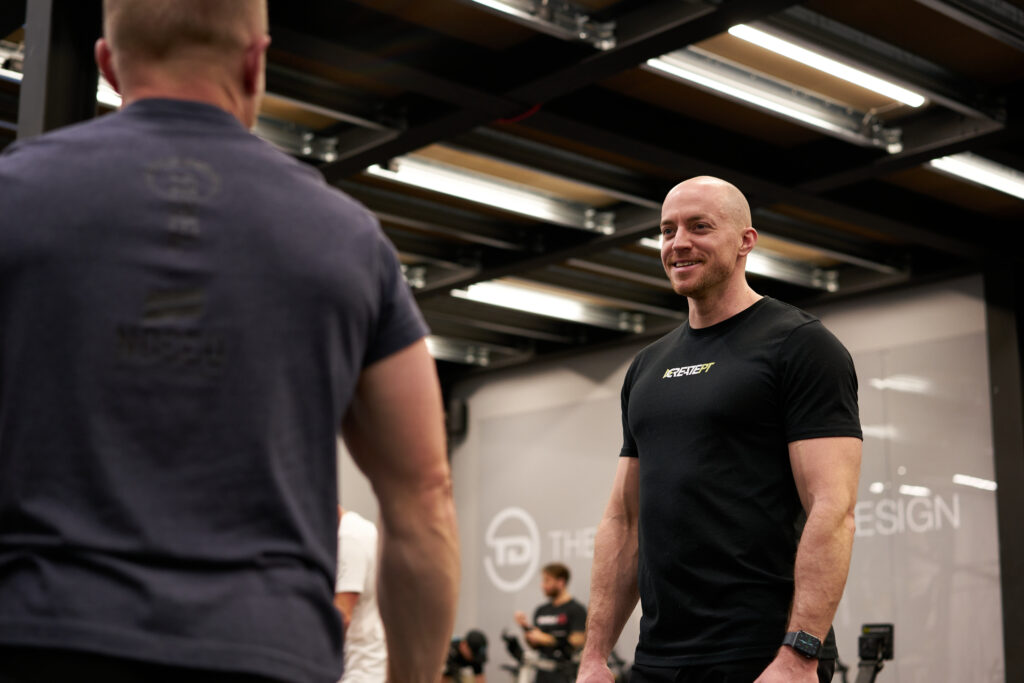
I am one of the owners of Create PT, but before starting Create PT, I started my career in the fitness industry setting up an Anytime Fitness franchise in 2014. I owned the gym for 8 years until I sold it in 2022. In fact my business partner Josh that I co-own Create PT with was the first self employed PT we took on at the gym when we first opened. We set up Create PT in 2018 in response to the poor quality education options at the time, and the low standard of PTs we came across, but that’s another story…
There are definitely benefits of franchising. As a first time business owner I didn’t know where to get started, especially with something as big as owning a gym. The barriers to entry were massively lowered; instead of needing to build a brand from scratch, understand how to build and design a gym, sell memberships, market it effectively and everything else that goes with owning a gym, a load of these things were done for me, or atleast systemised to make them easier for me to manage. This may make it sound easier than it was, I still had to do all the hard work, I just didn’t need to figure out how to do it all from scratch.
In addition to providing a “turnkey” solution, most franchise networks also offer ongoing support. With Anytime Fitness they offered a more hands off approach than a lot of franchise businesses. With McDonalds for example there is an exact way every menu item needs to be prepared, a blueprint for exactly how the restaurant needs to look and be maintained, uniform, staff expectations and tons more, so that as a customer whenever you go to a McDonalds, you’re getting a consistent experience. However with a gym it can’t be systemised as much as this, it is a service business rather than a product business, so the customer experience is much more down to the owner and staff of each branch.
As such Anytime Fitness head office did not intervene too much in the day to day running of the club, provided you weren’t getting complaints or running the club in a way that negatively impacts their brand. On the flip side of that, they were available to help and support as much as needed (within reason), for myself I found I needed a fair bit of help at the outset, then after a while I liked that I was left to run the club how I wanted. I had built up enough experience to run it well without their help, so I only occasionally asked for support.
A clear benefit of franchising is the established brand and business model. This massively reduces the risks associated with setting up a new business, and bypasses a lot of the initial brand awareness marketing needed for new businesses. On the flip side, you’re restricted to running your business how they want it run, they have strict brand guidelines for you to follow, equipment providers you have to buy from, design layouts to follow, systems you have to use and processes you’re meant to follow. This can of course be a benefit, it just depends on you as an individual and how you like to run your business, and how good the franchisor is at all these things of course.
A fairly universal rule in business is that of “economies of scale”. This means if you’re buying more of something, you can usually negotiate a better price. This is another great benefit of owning a franchise gym. Rather than being approaching equipment providers, consumables, cleaning products, electricity providers and everything else you need as the owner of a single-site independent gym, you’re approaching them as part of a large organisation with huge buying power. This means either they can negotiate better deals on your behalf, or you can use the brand power to negotiate better deals yourself. One particular benefit was the deals we had with 2 main equipment providers. We were limited to buying from either Life Fitness or Precor, which was sometimes a bit of a pain, but the benefit was that we paid almost 60% less than RRP for most kit.
With anything in life, if it sounds too good to be true, it probably is, so always make sure to do your research and find out the downsides too. When enquiring with franchisors about buying into their network, they will inevitably only tell you the good stuff, so fortunately I can shed some light on the negatives for you.
Although the barrier to entry is lowered in terms of what you need to know and do, the financial barrier is probably higher overall. Although you have the economies of scale of the franchise network, in addition to all the costs that go with setting up a gym, there is the added cost of the franchise fees. These come in the form of a pretty hefty upfront payment and a monthly payment for the continued use of the brand and support. I can’t speak to other brands, but with AF this was not cheap. One positive was that the monthly payment was a fixed amount and not linked to turnover, but depending on your revenue that could also be a bad thing. The franchisor will obviously try to justify the franchise fees with what they’re offering in return, so just make sure you understand the extent of the fees and whether what you’re getting in return is worth it.
The flip side of having a done-for-you business model is that the franchisor wants to protect what they have created. The power of their brand is in the uniformity from site to site, so if they have franchisees in the network that are not cooperating or are operating outside the SOPs (standard operating procedures), this could damage their brand. Understandably, to prevent this they have measures in place to ensure consistency from site to site, and for me this was a downside. However it is not AFs fault, it is more of a me problem. I enjoy building my own brand, running it how I want to run it, knowing that what I’m doing is in the best interest of my business. So when I wanted to make certain decisions that I felt were in the best interest of the business, and I was told I was not allowed, I found this frustrating. But, like I say, this is known from the outset, that part of franchising is you do things how they want you to do them, so as long as you’re ok with that, then it isn’t a problem.
Although we operated a gym which is obviously part of the fitness industry, more of the day to day focus was on sales and member retention than the provision of fitness services. This varies between different gym models, for example Crossfit gyms tend to focus much more heavily on the coaching and programming and not so much on selling memberships. I’d say franchise gyms such as Anytime Fitness and Snap Fitness are at the other end of this spectrum, they have much less focus on health and fitness related services and much more on selling memberships, streamlining operations and maximising profitability.
This can of course make it a more attractive business model from a financial perspective (if the club is successful), but I found after a while that it no longer aligned with my personal preferences and values. As much as I love running a business, I also love the fitness industry and what it can do for people, and I found myself training at another gym (partly so I could train in peace) but partly because I wanted a gym with more of a community and more of a focus on improving performance. An Anytime club leans more towards people looking for convenience and a relatively low price, and not towards people that take their training seriously.
One of the biggest frustrations I found over the course of owning the gym was the hierarchy and how the relationships worked between the different stakeholders involved, it’s a bit of a strange dynamic.
With a traditional corporate structure, all parties are more or less driving towards the same goal, which is improving profitability/growth/revenue for the business. However with a franchise, the franchisees are effectively the customers of the franchisor. Yes, the franchisor will ultimately only make money if the gyms within the network have enough members to be operational, but they are not incentivised financially to help the individual gyms become more profitable, because they’re earning their money from franchise fees, not from membership fees.
Additionally, the people advising franchisees work for the franchisor. Some of them were great, but in general they’re being paid a wage to do a job and hit targets, and their job involved instructing business owners on how to run their businesses. So there was this strange dynamic sometimes where a performance consultant (or whatever their job title is) would be assigned to your club by head office to support you, yet they lacked any real world experience in running a business themselves, and were essentially just following their training by head office and trying to meet their own targets so they looked good to their employer, rather than having any real vested interest in the success if your business. A lot of what they had to do to help us felt like a tick-box exercise they were completing to satisfy their boss, rather than adding any real value to us.
I’ve written this article from my personal perspective, so I appreciate that not everyone will feel the same way about franchising, but hopefully it gives you some honest insight into the process.
Owning the Anytime Fitness gym for that time taught me a lot, I met a lot of great people, and it gave me the platform from which I was able to launch Create PT which I much prefer. I was also able to sell the gym and get out relatively unscathed following the COVID lockdowns, so there have definitely been positives.
For me though, the negatives slightly outweigh the positives. The franchise fees are a non-negotiable expense each month, not to mention the initial franchise fee you pay before you are even able to secure a location. But if your financial models for the business work, then these fees are just part of doing business. For me, the main reason I personally don’t recommend it is because I like the flexibility to run a business how I want to, I want control of the branding, the customer experience, the systems and processes we use, the marketing strategy, who we work with and what advice we take.
Like I said earlier, these constraints can be perfect for some people, they provide you with tried and tested methods for running a business that should lead to success, they’re just not for me. So as with any new business venture, be extremely thorough with your research and due diligence, not just with the usual stuff like market research and finding the right location, but also make sure you dig deep into the franchisor, speak to other franchisees and make sure you’re happy with the fee structure and restrictions as well as all the great stuff they’ll be telling you.
Author: Adam Rhodes (Director of Create PT)
Robert Taylor
Head of Marketing
Robert has spent ten years in digital marketing, eight of them around this industry: four with Future Fit as a client and four working inside it. He owns how Create is found, what it says about its courses, and whether that turns out to be true.
Reviewed by Ollie Bell, Award winning, published author, certified at Harvard and Oxford.
More about Robert →